
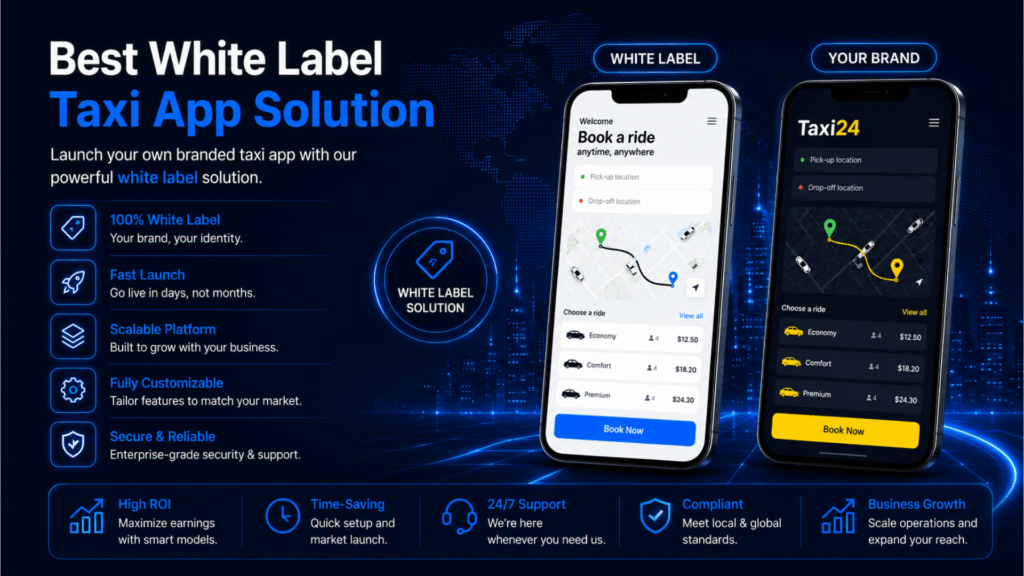
Why Choosing the Right White Label Taxi Platform Matters
The white label taxi app market includes a wide range of providers — from established mobility software companies with deep operational experience to script sellers offering cheap, lightly tested deployments with minimal support.
For a taxi business founder or operator, this variety can make comparison difficult. Many platforms look similar on a features list. The differences that matter — platform stability, customisation depth, post-launch support quality, and vendor reliability — rarely appear in a product brochure.
This guide provides a structured framework for evaluating white label taxi app solutions. It does not rank specific vendors, because the best platform for your business depends on your market, operational model, and growth stage. Instead, it gives you the evaluation criteria and the questions to ask so you can make an informed decision.
What Is a White Label Taxi App Solution?
A white label taxi app solution is a pre-built, fully functional taxi booking platform developed by a software provider and made available for licensing to taxi businesses. The platform includes the core operational components — rider app, driver app, admin panel, and dispatcher panel — and is delivered with the client’s branding, configured for their market and operational requirements.
The business does not build the software from scratch. Instead, it licenses a platform that has already been developed, tested, and deployed for other operators. Configuration, branding, and integration work bring the platform to market significantly faster than a custom build — typically within weeks.
White label solutions are used by startups launching new taxi services, existing operators digitising their fleets, and mobility entrepreneurs entering ride-hailing markets without the time or budget for custom taxi app development.
The Eight Criteria for Evaluating a White Label Taxi App Solution
When comparing white label taxi platforms, evaluate each option against the following criteria. This framework moves beyond features lists to focus on the factors that determine whether a platform will actually support your business in practice.
1. Feature Completeness Across All Four Components
A complete white label taxi app solution must include all four platform components: rider app, driver app, admin panel, and dispatcher panel. Some providers offer reduced packages that omit the dispatcher panel or deliver a minimal admin panel that lacks key management capabilities. Evaluate feature completeness across all four components before shortlisting.
Core rider app features to verify: booking flow, fare estimate, live tracking, multiple payment options, in-app wallet, trip history, ratings, SOS safety, and in-app support.
Core driver app features to verify: document upload and onboarding, trip request management, in-app navigation, trip status controls, earnings dashboard, availability toggle, and ride history.
Core admin panel features to verify: driver and rider management, fare and pricing configuration, booking monitoring, commission and payout management, zone management, promotional tools, and reporting and analytics.
Core dispatcher panel features to verify: live map with driver visibility, manual trip assignment, booking creation, and driver communication tools.
2. Customisation Depth
White label customisation operates at two levels: surface-level branding and operational configuration. Understanding which level of customisation a platform supports — and where its limits are — is essential before committing.
Surface-level branding includes logo, colour scheme, app name, and basic UI styling. This is available on virtually every white label platform and should not be the basis for differentiation.
Operational configuration is where meaningful differences emerge. Evaluate whether the platform supports:
- Custom fare structures including base rate, per-km rate, waiting time charges, and minimum fare
- Service-type configuration for different vehicle categories or ride types
- City and zone-level pricing and operational settings
- Commission structures that match your business model
- Driver onboarding workflows that reflect your verification and compliance requirements
- Promotional and referral programme configuration
Platforms that support deep operational configuration give operators meaningful control without requiring custom development. Platforms that offer only surface branding are effectively generic scripts with your logo applied.
3. Scalability and Platform Architecture
A white label platform that handles your launch volume smoothly may not handle your growth trajectory equally well. Evaluate scalability across two dimensions: technical capacity and operational complexity.
Technical capacity refers to how the platform handles increasing trip volume, driver and rider counts, and geographic expansion. Ask the vendor about performance benchmarks, infrastructure approach, and how the platform has scaled for existing clients.
Operational complexity refers to whether the platform can support more sophisticated business requirements as the operation grows — multi-city configurations, multiple service types, corporate account management, and advanced analytics. A platform that works for a 50-driver single-city operation may be inadequate for a 500-driver multi-city business.
The key question to ask any white label vendor: what is the largest and most complex deployment currently running on this platform, and what does it look like operationally?
4. Integration Flexibility
No taxi platform operates in isolation. It requires integrations with mapping providers, payment gateways, SMS and notification services, identity verification tools, and in some cases accounting or CRM systems. Evaluate which integrations are pre-built into the platform and how easy it is to add or change them.
Key integration areas to assess:
- Mapping and routing providers — Google Maps, Mapbox, HERE, or others relevant to your market
- Payment gateways — local and international options supported for your target market
- SMS and push notification providers
- Identity and document verification services
- Analytics and business intelligence tools
Platforms with rigid integration sets may create ongoing cost or operational problems if the pre-integrated payment gateway is not supported in your market, or if your riders expect a payment method the platform does not accommodate. Flexibility on integrations is particularly important for operators targeting markets with specific local payment preferences.
5. Post-Launch Support Quality
Post-launch support is the most undervalued factor in white label platform selection and one of the most consequential. When a critical issue occurs — a payment processing failure, a driver allocation bug during peak hours, or a data synchronisation problem — the quality of your vendor’s support response determines how quickly the business recovers.
Evaluate support quality across:
- Response time commitments for critical and non-critical issues
- Support channel availability — ticketing system, email, direct contact for urgent issues
- Time zone coverage relative to your operating market
- Track record of support quality from reference clients
- Clarity on what is covered under standard support versus additional fees
A white label platform with strong features but poor support is a higher operational risk than a slightly less feature-rich platform backed by a responsive, experienced support team. For a business that depends on its platform being operational every day, support quality is not a secondary consideration.
6. Vendor Experience and Stability
The vendor’s experience and business stability should factor into your evaluation. A white label platform built and maintained by a company with deep experience in taxi app development and real-world deployments across diverse markets is a more reliable foundation than a newer entrant offering lower prices.
Signals of vendor credibility to look for:
- Years in operation and track record of platform deployments
- Number of active deployments and diversity of markets served
- Transparency about the platform’s technical architecture and development roadmap
- Client references or case studies from comparable businesses
- Stability indicators — team size, operational continuity, and how long they have maintained the platform
A vendor that has been building and supporting taxi platforms since before the smartphone generation has navigated technology shifts, market changes, and client challenges that newer providers have not encountered. This experience translates into a more stable product and more reliable guidance.
7. Deployment Timeline and Onboarding Process
White label solutions vary in how quickly they can be deployed and how structured the onboarding process is. Evaluate the vendor’s standard deployment timeline, what is included in onboarding, and how the platform is configured and tested before go-live.
Questions to ask:
- What is the standard deployment timeline from contract signing to go-live?
- What does the configuration and setup process involve?
- How is the platform tested before launch — and who is responsible for testing?
- What training or documentation is provided to the operations team?
- What does a typical launch support period look like?
A vendor with a clear, structured onboarding process reduces the risk of launch delays and ensures the platform is properly configured for your market before your first riders and drivers use it.
8. Total Cost of Ownership
The entry cost of a white label taxi app is only one element of the total cost of ownership. A complete cost assessment should account for:
- Initial licensing or setup fee
- Monthly or annual platform licensing fees
- Per-trip or usage-based fees if applicable
- Cost of additional features or modules beyond the standard package
- Integration costs for mapping, payments, and notification providers
- Post-launch support and maintenance fees
- Cost of customisation work required beyond standard configuration
A platform with a low headline price but high per-trip fees, expensive add-ons, and costly support may have a higher total cost of ownership than a platform with a higher upfront licence fee but inclusive support and more comprehensive standard features. Evaluate the full cost picture over a 12 to 24 month operating horizon, not just the launch investment.
White Label Taxi App Evaluation Checklist
Use this checklist when comparing white label platforms. Prioritise the criteria that matter most for your specific business stage and market.
| Evaluation Area | Questions to Ask the Vendor | Why It Matters |
|---|---|---|
| Feature Completeness | Does the platform include all four components with full core features? | Gaps in any component create operational problems from day one |
| Customisation Depth | Can pricing, commission, zones, and workflows be configured to my model? | Operational flexibility reduces dependence on developer support |
| Scalability | What is the largest active deployment on this platform? | Determines whether the platform can support growth |
| Integration Flexibility | Which payment gateways and mapping providers are supported in my market? | Incompatible integrations create cost or service gaps |
| Post-Launch Support | What is the response time SLA for critical issues? | Support quality determines operational resilience |
| Vendor Experience | How many taxi platforms has this vendor deployed and in which markets? | Experience reduces risk of unexpected technical and operational problems |
| Deployment Timeline | What does the standard deployment and onboarding process include? | Clarity here prevents launch delays and configuration gaps |
| Total Cost of Ownership | What are all fees over 12 to 24 months of operation? | Headline price rarely reflects true operational cost |
Red Flags to Watch for When Evaluating White Label Taxi Platforms
Watch Out For These Warning Signs
Vague or missing post-launch support commitments. No verifiable reference clients or active deployments. Per-trip pricing that scales aggressively with volume. Extremely low headline prices without clear explanation of what is excluded. Vendor reluctance to discuss platform architecture or scalability in specific terms. Onboarding described as simple or instant without a structured configuration process. Feature lists that do not distinguish between included and paid add-ons.
These signals do not always indicate a poor vendor, but they warrant careful investigation before committing. The taxi platform market includes providers at very different levels of maturity and reliability, and the consequences of choosing poorly are experienced by your riders and drivers — not the vendor.
What a Strong White Label Taxi App Solution Looks Like
The best white label taxi app solution for your business is one that delivers across all eight evaluation criteria in a way that fits your operational model and growth stage. In practice, a strong white label solution has the following characteristics:
| Characteristic | What It Looks Like in Practice |
|---|---|
| Complete platform ecosystem | All four components — rider, driver, admin, dispatcher — fully functional at launch |
| Operational configurability | Pricing, zones, commission, and workflows adjustable without developer involvement |
| Proven deployment history | Active deployments in comparable markets with reference clients available |
| Responsive support structure | Named support contacts, defined response times, and transparent SLA commitments |
| Scalable architecture | Platform has supported growth beyond the launch stage for existing clients |
| Flexible integrations | Payment and mapping providers available for your specific market |
| Transparent total cost | All fees clearly explained across the full operating lifecycle |
| Structured onboarding | Defined deployment process with testing, configuration, and launch support |
Choose a White Label Taxi Platform That Works Beyond the Demo
The white label taxi app market has no shortage of options. The challenge is not finding platforms to consider — it is finding the one that will still be serving your business reliably when you have 200 drivers operating across three cities.
Evaluate on the criteria that matter for long-term operational performance: feature depth, configurability, scalability, support quality, and vendor experience. Make the decision based on what the platform does in real deployments, not what it looks like in a sales presentation.
How We Deliver White Label Taxi App Solutions
Since 2012, we have deployed white label taxi app solutions for businesses across 95+ countries. With 400+ projects delivered, our platform has been tested across diverse markets, regulatory environments, operational models, and business scales.
Our white label solution includes the full four-component ecosystem — rider app, driver app, admin panel, and dispatcher panel — built for operational environments rather than demos. The platform supports deep configuration across pricing, zones, commission structures, driver workflows, and service types without requiring custom development for standard operational requirements.
Post-launch support is structured, responsive, and backed by a team that understands taxi operations from the inside. Our onboarding process is designed to get the platform configured correctly for your market before your first rider opens the app — not after.
We work with businesses at every stage: startups launching their first platform, operators digitising existing fleets, and established companies expanding into new markets. The starting point is always the same — understanding your business model before recommending a deployment approach.
Frequently Asked Questions
To compare your options with a specialist, get a free platform consultation.
There is no single best white label taxi app solution for every business. The best platform for your operation depends on your market, business model, budget, growth stage, and operational requirements. The right way to identify the best solution is to evaluate vendors against a structured framework covering feature completeness, customisation depth, scalability, integration flexibility, support quality, vendor experience, deployment process, and total cost of ownership.
A complete white label taxi app solution should include a rider app with booking, live tracking, multiple payment options, and safety features; a driver app with trip management, navigation, and earnings visibility; an admin panel with pricing configuration, driver management, payout controls, and analytics; and a dispatcher panel for manual trip assignment and fleet monitoring. Solutions that are missing any of these components have operational gaps that will affect day-to-day management.
Most white label taxi app solutions can be deployed within 4 to 10 weeks, depending on the complexity of the configuration, the number of customisations required, and the integration work needed for your specific market. A well-structured deployment process with clear milestones typically delivers a go-live ready platform faster and with fewer issues than an unstructured rushed deployment.
Yes, most modern white label taxi app platforms are designed to scale with the business. Scalability should be verified during the evaluation process by asking the vendor about their largest active deployments and how the platform has performed as clients have grown. Operational complexity — such as multi-city management, enterprise accounts, and advanced analytics — may reach configuration limits on some platforms that technical volume does not.
Compare white label taxi solutions across eight criteria: feature completeness across all four platform components, customisation depth for pricing and operational configuration, scalability for both technical volume and operational complexity, integration flexibility for your specific market’s payment and mapping needs, post-launch support quality, vendor experience and deployment track record, deployment timeline and onboarding process, and total cost of ownership across the first 12 to 24 months of operation.
The term Uber clone is commonly used in the taxi app market to describe ride-hailing software that replicates the core functionality of the Uber platform. A white label taxi app solution is a broader category that includes platforms built for professional licensing across a range of taxi and mobility business models — not all of which follow the Uber operational model. While there is overlap in the market, white label taxi platforms built by experienced mobility software providers tend to offer greater operational depth, configurability, and support quality than basic clone scripts sold at low price points.
For most businesses launching a taxi service for the first time, a white label solution is the smarter starting point — it reduces risk, shortens the launch timeline, and requires a lower initial investment. Custom development is more appropriate when your business model requires workflows, features, or platform logic that white label solutions cannot support, or when full IP ownership is a strategic priority. Many successful taxi businesses start with white labels to validate their market and then invest in custom development once operational experience informs a more precise platform brief.