
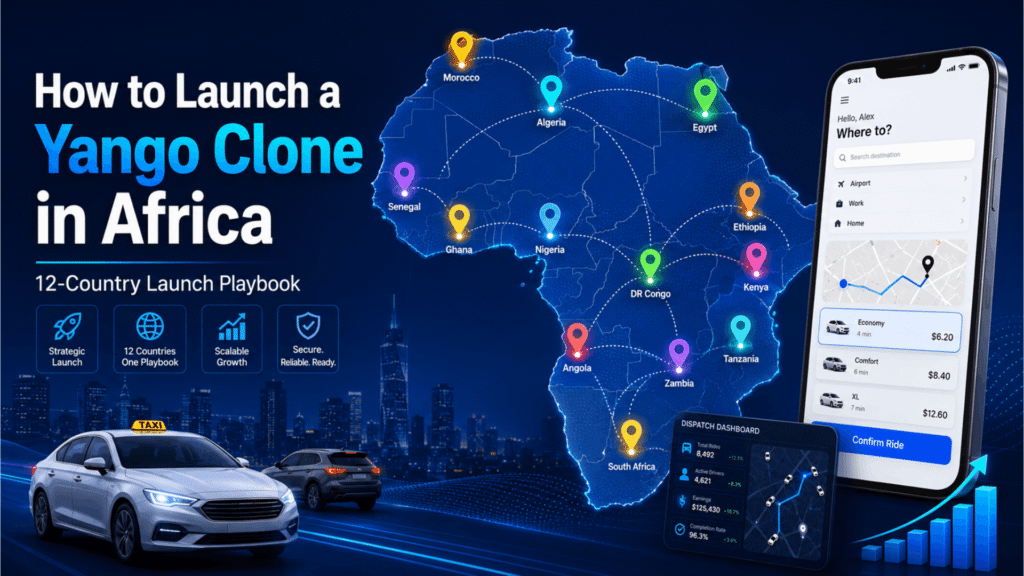
Why Africa Is the Best Yango Clone Opportunity in 2026
The case for launching a Yango clone in Africa rests on four converging trends. Smartphone penetration in sub-Saharan Africa has crossed 50% across most major cities and is rising. Mobile-money usage is mature in Kenya, Tanzania, Ghana, Senegal and Uganda — markets where 60-80% of adults use M-Pesa, MTN MoMo or Orange Money daily. Urban ride-hailing demand is far larger than current platforms can serve, with Uber active in only a handful of capital cities and Bolt focused on similar urban concentrations. And Yango itself has spent the past four years validating which African markets have launch-ready demand, doing the market research that competing entrants no longer need to repeat.
For a local entrepreneur, the strategic question is no longer “is there demand?” — Yango has answered that. The question is “can I capture share before Yango fully establishes supply in my city, or in a city Yango has not yet entered?”
Where Yango Already Operates in Africa
As of 2026, Yango Ride is live in 12 African countries:
- Ghana (since 2019) — well-established, Accra and Kumasi.
- Senegal (since 2021) — Dakar and surrounding cities. Yango Deli grocery also active.
- Côte d’Ivoire (since 2021) — Abidjan core. Yango Eats launched 2023.
- Cameroon (since 2021) — Douala and Yaoundé.
- DRC (since 2022) — Kinshasa primarily.
- Angola (since 2022) — Luanda.
- Mozambique (since 2022) — Maputo.
- Zambia (since 2022) — Lusaka. Yango Eats added 2023.
- Namibia (since 2023) — Windhoek.
- Ethiopia (since 2023) — Addis Ababa.
- Morocco (since 2023) — Casablanca and Rabat.
- Nigeria — recent partial entry in select cities.
This leaves a substantial whitespace: Kenya, Uganda, Tanzania, Rwanda, Botswana, Mauritius, Madagascar, Tunisia and many West African countries where a branded local super-app can launch ahead of Yango or in markets where Yango has decided not to enter.
The Top 5 Opportunity Markets in 2026
1. Nigeria
Lagos alone is 22 million people. Mobile-money is rapidly maturing through Opay, PalmPay and Flutterwave. Yango entered late and remains thin. A locally-branded super-app combining rides + food + courier in Lagos, Abuja or Port Harcourt is one of the strongest mobility plays globally in 2026.
2. Kenya
Nairobi has high smartphone penetration, mature M-Pesa rails covering 95%+ of urban adults, and a sophisticated user base familiar with ride-hailing. Yango has not entered Kenya. Uber and Bolt operate but are vulnerable to local competition on pricing and multi-service convenience.
3. Tanzania
Dar es Salaam is growing fast, has M-Pesa and Tigo Pesa infrastructure, and minimal super-app competition. Lower entry costs than Kenya or Nigeria. Strong fit for an entrepreneur with $50-100k in launch capital.
4. Côte d’Ivoire (alongside Yango)
Abidjan already has Yango but the market is large enough for a strong local alternative. French-speaking advantage. Orange Money is the dominant payment rail. A focused alternative with better driver economics can carve out 15-25% market share.
5. Senegal (alongside Yango)
Dakar similar dynamic to Abidjan. Yango is established but not dominant. Local-language UI (Wolof + French) and aggressive driver-supply incentives can win significant share.
Other strong-fit markets worth exploring: Uganda (Kampala), Rwanda (Kigali), Ethiopia (regional cities outside Addis), Mauritius and the entire francophone West Africa belt (Mali, Burkina Faso, Togo, Benin).
Payment Rails: Mobile Money Is Non-Negotiable
The biggest mistake international entrants make in Africa is underestimating mobile-money. In most African cities, cards are used by less than 15% of urban adults. Mobile money is used by 60-90%. Any Yango clone launching in Africa must support, at minimum:
- M-Pesa (Kenya, Tanzania, Mozambique, DRC, Egypt, Ethiopia, Lesotho)
- MTN Mobile Money (Uganda, Ghana, Côte d’Ivoire, Cameroon, Rwanda, Zambia, Benin, Liberia, South Sudan, Guinea, Congo-Brazzaville)
- Orange Money (Senegal, Mali, Côte d’Ivoire, Burkina Faso, Madagascar, DRC, Egypt, Cameroon, Botswana)
- Airtel Money (Uganda, Tanzania, Kenya, Rwanda, Zambia, Malawi, Madagascar)
- Wave (Senegal, Côte d’Ivoire, Uganda)
- Flutterwave / Paystack / Opay / PalmPay (Nigeria)
Our Yango clone platform includes pre-integrated support for all of the above. A platform without mobile-money native support is functionally unlaunchable in Africa — riders will not adopt it.
For a full breakdown of payment integration and pricing, see our Yango Clone App Development Cost guide.
Regulation & Licensing by Country
Ride-hailing regulation varies significantly across Africa. Brief overview of major markets:
- Nigeria — Federal Road Safety Corps regulates intercity. Lagos requires a state operator licence (Lagos State Ride-Hailing Operators Regulation). Budget 3-6 months for licensing.
- Kenya — NTSA (National Transport and Safety Authority) regulates. Operator licence required. Capping rules on commission rates introduced in recent years.
- Ghana — Driver and vehicle registration required through DVLA. Lighter operator regulation than Kenya or Nigeria.
- Senegal & Côte d’Ivoire — Ministry of Transport regulation. Local-content rules favouring locally-registered companies.
- South Africa — Provincial regulation (Gauteng most active). Operator licensing required.
- Egypt — Ride-hailing law since 2018 requires registration with Ministry of Transport. E-invoicing compliance (ETA) recently extended to ride-hailing.
Regulatory work runs in parallel to platform development. Plan 60-120 days for licensing in most major markets.
The Africa Launch Playbook (Step by Step)
The proven Yango clone launch sequence in an African market:
- Market selection & due diligence (2-4 weeks). Confirm city demand, regulatory feasibility and payment-rail availability. Visit the city if possible.
- Local entity setup (4-8 weeks, parallel). Incorporate locally, secure operator licence (where required), open business bank account.
- Platform build (5-10 weeks). Yango clone build with rides + courier in pilot vertical config. Local-language UI, mobile-money integration, regional dispatch rules.
- Driver recruitment pilot (2-4 weeks). Sign 50-150 drivers before public launch. Bonus pool for first 1,000 trips per driver.
- Soft launch in one district (4-6 weeks). Launch in one neighbourhood of pilot city. Refine pricing, dispatch logic, support response time.
- City-wide launch + marketing (ongoing). Open to full city. Performance marketing on Instagram, Facebook, TikTok, plus driver referral bonuses to scale supply.
- Vertical expansion (months 4-8). Once driver supply is stable and ride economics are positive, enable food delivery and grocery from the same admin panel.
The 6 Most Common African Launch Mistakes
- Launching without cash and mobile money. Card-only platforms fail in Africa. Always launch with cash + at least two mobile-money rails.
- Underpricing driver bonuses in the first 90 days. Driver supply is the make-or-break variable. Plan a $20-40k bonus pool for the first 90 days minimum.
- Skipping local-language UI. English alone is insufficient in most West and Central African cities. French, Swahili, Wolof, Hausa, Amharic — pick what matters.
- Treating mobile money as a card alternative. Mobile money has different UX patterns (USSD prompts, push-to-confirm). Build for them, do not adapt card flows.
- Underestimating regulatory timeline. Operator licensing in Lagos, Nairobi, Cairo can take 90-180 days. Start in parallel with platform build, not after.
- Launching food delivery in month one. Drivers will not commit to delivery jobs before they are earning consistently from rides. Sequence: rides first, courier second, food third.
Frequently Asked Questions
Can I launch a Yango clone in a city where Yango already operates?
Yes. Most ride-hailing markets in Africa support 2-4 competing platforms. Local-brand advantages, better driver economics and faster customer support frequently let new entrants capture 15-30% market share within 18 months, even against Yango or Uber. The platform-level competition is secondary to driver supply and customer acquisition.
How much capital do I need to launch in an African city?
Plan for $80,000-$200,000 in first-12-month capital: $40-80k for the platform itself, $20-50k for driver bonuses and customer acquisition, $10-30k for legal, licensing and local setup, $10-40k for working capital and team. A leaner launch is possible in smaller cities (Kumasi, Dakar) for $60-100k.
Which African country has the easiest regulatory environment?
Ghana is generally considered the easiest first-time launch market: stable regulation, dominant mobile-money rails (MTN, Vodafone Cash), large English-speaking urban population and proven ride-hailing demand. Most US/UK-based founders piloting their first African mobility business start in Accra.
Do I need a local co-founder or partner?
Not legally required in most markets, but operationally invaluable. A local operating partner who handles driver community, government relations and on-the-ground marketing is the difference between a smooth launch and an 18-month learning curve.
Can I run multiple African cities from one platform?
Yes — the Yango clone is built multi-city from the ground up. Independent fare rules, vehicle types, languages and merchant catalogues per city, all managed from one centralised admin panel. Many of our clients launch in one city then add 2-3 more within 12 months.
Where can I see the full Yango clone platform specs?
The full feature set is on our Yango Clone Super-App solution page, with a comparison to single-vertical alternatives in our Yango Clone vs Uber Clone guide.