
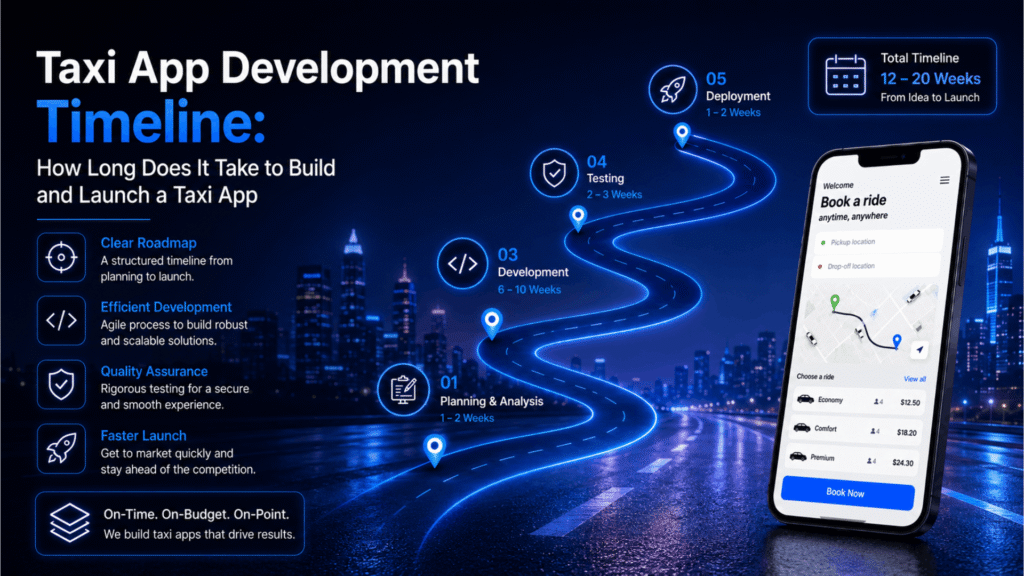
The Short Answer
Taxi App Development Timeline — Quick Reference
White label taxi app deployment: typically 4 to 10 weeks. Custom taxi app development MVP: typically 4 to 7 months. Full-featured custom platform: typically 7 to 12 months or more. The actual timeline depends on your development model, feature scope, integration requirements, and how quickly decisions and approvals are made on your side.
Timeline is one of the first practical questions any founder or operator asks when evaluating a taxi app project. The answer is genuinely variable — and businesses that plan based on an optimistic estimate rather than a realistic one tend to face avoidable delays and budget overruns.
This guide breaks down the taxi app development timeline by development model and phase, explains what drives timelines up or down, and gives you a practical framework for planning your launch.
Why Taxi App Development Timelines Vary
Two taxi businesses can ask for the same thing — a fully functioning taxi booking platform — and face timelines that differ by months. The difference comes down to five core variables.
1. Development Model: White Label vs Custom
This is the single largest determinant of timeline. A white label taxi app solution is pre-built. The platform already exists, has been tested in live deployments, and is ready to be configured and branded for a new client. The work before launch is configuration, branding, integration setup, and testing — not development.
Custom taxi app development starts from a blank slate. Design, architecture, development, testing, and deployment all need to happen before the first rider can open the app. This is a fundamentally different scope of work, and it takes proportionally longer.
2. Feature Scope
A platform with a focused core feature set takes less time to build than one with complex additions. For custom taxi app development, scope is the most controllable timeline variable — a leaner MVP can launch faster and be extended post-launch, while a fully featured platform built upfront takes longer to complete and validate.
3. Integration Complexity
Every third-party integration — payment gateway, mapping provider, SMS service, identity verification tool — adds configuration and testing time. Markets with non-standard payment requirements or limited mapping API support create additional integration work that is not always visible in early timeline estimates.
4. Decision Speed on the Client Side
One of the most commonly underestimated timeline factors is how quickly the business can make decisions and provide the inputs the development team needs. Branding assets, operational settings, pricing structures, legal and compliance documentation, and feedback on test builds all require timely input from the client. Delays here extend the timeline just as much as technical complexity.
5. App Store Review and Compliance
Publishing mobile apps to the Apple App Store and Google Play involves a review process that is outside the development team’s control. App store reviews typically take a few days but can take longer, particularly for first-time submissions or apps that require additional compliance documentation in regulated markets. This step is often excluded from development timeline estimates and should be planned for separately.
White Label Taxi App Deployment Timeline
For businesses choosing a white label solution, the deployment process moves through a defined set of phases. Each phase has a typical duration, though the actual time depends on vendor capacity, configuration complexity, and client responsiveness.
| Phase | What Happens | Typical Duration |
|---|---|---|
| Discovery and scoping | Business requirements, market settings, service types, and integration needs are confirmed | 3 to 5 days |
| Branding and UI configuration | Logo, colour scheme, app name, and visual identity applied across all four components | 5 to 7 days |
| Operational configuration | Pricing, zones, commission, driver onboarding workflow, and payment integrations configured | 1 to 2 weeks |
| Integration setup | Payment gateway, mapping provider, and notification services connected and tested | 1 to 2 weeks |
| Internal testing and QA | Platform tested across all components — booking flows, payment processing, live tracking, admin | 1 week |
| Client review and sign-off | Business owner reviews the configured platform and approves for launch | 3 to 5 days |
| App store submission | Rider and driver apps submitted to Apple App Store and Google Play | 3 to 7 days |
| Go-live and launch support | Platform goes live with active vendor support for early operational issues | Ongoing |
Total typical deployment window: 4 to 10 weeks. Deployments at the shorter end of this range involve straightforward configurations with a single service type, standard integrations, and a client team that responds quickly. Deployments at the longer end typically involve multi-city configuration, complex integration requirements, or additional compliance work.
Custom Taxi App Development Timeline
Custom development timelines depend heavily on the scope of the platform being built. The following framework reflects typical timelines across three scope levels.
| Scope Level | What It Includes | Typical Timeline |
|---|---|---|
| MVP — Core Platform | Rider app, driver app, admin panel, core booking and dispatch, single market | 4 to 7 months |
| Standard Platform | Full feature set across all components, multiple integrations, one or two markets | 7 to 10 months |
| Advanced Platform | Enterprise features, multi-market, AI-driven dispatch, complex integrations | 10 to 14+ months |
Custom Development Phase Breakdown
Regardless of scope level, custom taxi app development moves through the following phases.
| Phase | What Happens | Typical Duration |
|---|---|---|
| Discovery and scoping | Business requirements, technical architecture, and feature scope fully defined | 2 to 4 weeks |
| UI/UX design | Wireframes and visual designs created for all four platform components | 3 to 5 weeks |
| Core development | Rider app, driver app, admin panel, and dispatcher panel built in parallel sprints | 8 to 20 weeks depending on scope |
| Third-party integrations | Payment gateways, mapping, notifications, and other external services integrated | 2 to 4 weeks |
| Internal testing and QA | Platform tested across all components and use cases in staging environment | 2 to 4 weeks |
| Client UAT | Business team tests the platform against real operational scenarios and approves | 1 to 2 weeks |
| App store submission | Rider and driver apps submitted and reviewed by Apple and Google | 1 to 2 weeks |
| Launch and stabilisation | Platform goes live; development team monitors and resolves early production issues | 2 to 4 weeks |
What Causes Taxi App Development Timelines to Extend
Common Causes of Timeline Delays
Scope changes after development has begun — adding features mid-build is the most frequent cause of timeline extension in custom development. Slow client feedback during design and UAT phases — delays in approvals compound across phases. Integration problems with payment or mapping providers that are not discovered until testing. App store rejection requiring resubmission — especially for first-time submissions without a clear compliance review. Underestimated regulatory or compliance requirements in the target market. Configuration rework caused by incomplete operational decisions at the scoping phase.
Most timeline delays are avoidable with start with a free project scoping session, fast decision-making during the project, and realistic planning that includes buffer time for app store reviews and integration testing.
How to Shorten Your Taxi App Launch Timeline
Whether you are choosing white label or custom development, there are concrete steps that compress the path from decision to live platform.
For White Label Deployments
- Have branding assets ready before the project starts — logo, colour palette, app name, and any marketing imagery
- Confirm your pricing structure, service zones, and commission model before configuration begins
- Identify your payment gateway and mapping provider requirements for your market upfront
- Assign a single point of contact on your team who can review and approve each phase without delays
- Engage with app store developer accounts early — Apple Developer and Google Play account setup takes time if not already in place
For Custom Development
- Invest in thorough discovery and scoping before a line of code is written — ambiguity at this stage multiplies into weeks of rework later
- Prioritise ruthlessly for the MVP — launch with a focused, working platform rather than a delayed, comprehensive one
- Establish a responsive feedback cycle with the development team — quick approvals during design and UAT keep momentum
- Plan integration research early — payment and mapping provider requirements in your specific market should be confirmed during scoping, not discovered during development
- Build app store submission into the timeline from the start — do not treat it as a post-development formality
White Label vs Custom: Timeline Comparison at a Glance
| Timeline Factor | White Label | Custom Development |
|---|---|---|
| Time to first live booking | 4 to 10 weeks | 4 to 14+ months |
| Design work required | Branding and configuration only | Full UI/UX design from scratch |
| Development work required | None — platform is pre-built | Full build across all components |
| Integration setup | Pre-built options; market-specific config | Custom integration for each provider |
| App store submission | Included in deployment timeline | Separate phase; plan 1 to 2 weeks |
| Post-launch iteration speed | Dependent on vendor roadmap | Entirely within your control |
| Best for | Businesses with defined launch timelines | Businesses with complex, long-term builds |
Plan Your Taxi App Timeline Around Realistic Expectations
Taxi app development timelines vary widely — from weeks for a white label deployment to over a year for a complex custom build. The most important thing is to plan based on the right model for your business and set expectations that reflect the actual scope of work involved.
Businesses that plan realistically, make decisions quickly, and choose a vendor with a structured deployment process consistently reach launch faster than those that work from optimistic estimates and unclear scopes.
Since 2012, we have helped businesses across 95+ countries launch taxi platforms on time and to specification — through both white label deployment and custom development. If you want a realistic timeline assessment for your specific project, we are ready to help you plan it.
Frequently Asked Questions
To understand your exact development timeline, get a realistic launch timeline for your project.
The timeline depends on the development model. A white label taxi app can typically be deployed in 4 to 10 weeks. A custom-built taxi app MVP takes approximately 4 to 7 months, while a full-featured custom platform typically takes 7 to 12 months or more. The main variables are feature scope, integration complexity, the development model chosen, and how quickly decisions and approvals are made during the project.
A fully configured, tested, and live white label taxi app deployment in under a month is possible for straightforward configurations with standard integrations, fast client approvals, and favourable app store review timing. In practice, most white label deployments land in the 4 to 8 week range when all phases are accounted for realistically, including app store submission.
App store review timelines vary. Google Play reviews typically take 1 to 3 days for standard submissions. Apple App Store reviews typically take 1 to 5 days. First-time submissions, apps in regulated categories, or submissions that require additional review may take longer. App store review time should be planned for as a distinct phase in the deployment timeline rather than assumed to be instantaneous.
The fastest path to a live taxi app is a white label solution with a vendor who has a structured deployment process. By eliminating the development phase entirely, white label deployment compresses the timeline to configuration, integration, testing, and app store submission. Businesses that have their branding, operational settings, and integration requirements ready at the start of the project typically reach go-live in 4 to 6 weeks.
A focused custom taxi app MVP — covering the core booking flow, rider app, driver app, admin panel, and standard integrations — typically takes 4 to 7 months from scoping to launch. The lower end of this range applies to well-scoped projects with a single market, standard features, and a responsive client team. Projects that expand scope mid-development, face integration challenges, or have slow approval cycles tend toward the longer end.
The most common causes of timeline extension are scope changes added after development has started, slow client feedback during design and testing phases, integration problems discovered late in the build, app store rejections requiring resubmission, and underestimated compliance or regulatory requirements in the target market. Thorough upfront scoping and fast internal decision-making reduce most of these risks significantly.