
What Is Yango? (Quick Definition)
Yango is a multi-service mobility super-app operated by Yango Group, a technology company headquartered in Dubai, United Arab Emirates. It bundles ride-hailing, food delivery, e-grocery, in-app navigation and entertainment into a single consumer application, with separate dedicated apps for drivers, couriers, merchants and administrators.
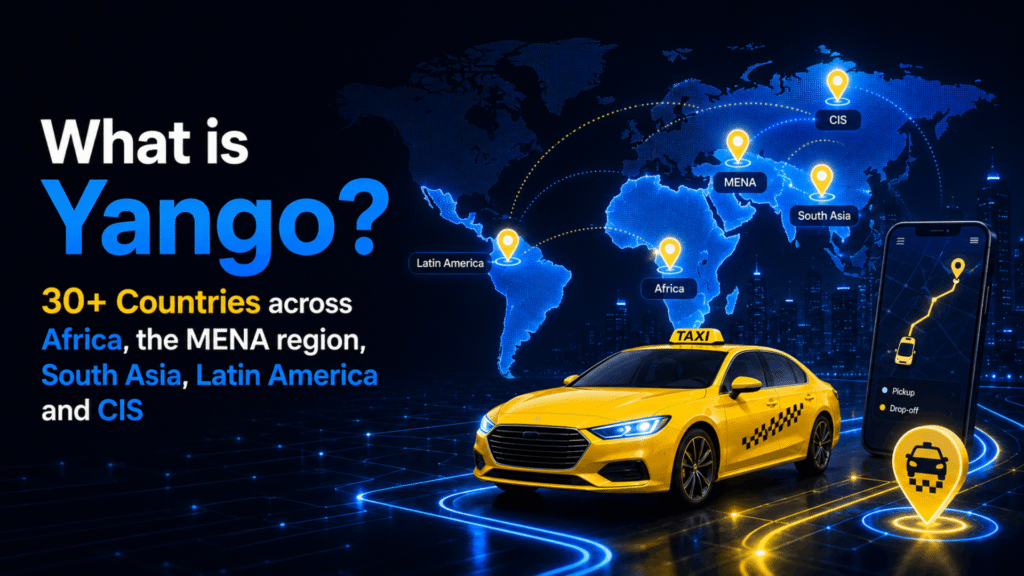
Originally launched as the international ride-hailing arm of Russian tech company Yandex, Yango became an independent group in 2022 and now operates in more than 30 countries across Africa, the Middle East, South Asia, Latin America and the Commonwealth of Independent States (CIS). Its flagship product, Yango Ride, is live in 25+ countries and is one of the fastest-growing ride-hailing services outside the United States and Western Europe.
Yango Group vs Yango App: The Difference
The names are often used interchangeably but refer to different things:
- Yango Group — the parent technology company based in Dubai. It builds and operates all Yango-branded products and services globally.
- Yango (the app) — the consumer-facing mobile application that bundles ride-hailing, delivery and other services. This is the product that users download and interact with.
- Yango Ride — the ride-hailing service inside the Yango app. The most widely-used Yango product, available in 25+ countries.
- Yango Pro — the dedicated driver app (formerly known as Taximeter). Used by drivers to receive ride requests, navigate trips and track earnings.
- Yango Eats / Yango Deli — food delivery and rapid grocery delivery products integrated into the main app.
- Yango Maps — the navigation engine that powers both driver routing and a public-facing maps product in some markets.
- Yango Play — an entertainment streaming app launched in seven MENA countries in early 2024.
Where Yango Operates: 30+ Countries Mapped
Yango’s geographic footprint spans four continents, with concentration in emerging-economy markets where traditional ride-hailing demand is high and competitive density is moderate. As of 2026, the active markets are:
Africa (12 countries)
Ghana, Senegal, Côte d’Ivoire, Cameroon, Democratic Republic of Congo, Angola, Mozambique, Zambia, Namibia, Ethiopia, Morocco and (recent expansion) Nigeria.
MENA and South Asia (10 countries)
United Arab Emirates, Egypt, Saudi Arabia, Kuwait, Qatar, Oman, Bahrain, Jordan, Pakistan and Bangladesh. The Gulf region is one of Yango’s highest-margin markets, while Pakistan and Egypt are among its highest-volume.
Latin America (4 countries)
Bolivia, Peru, Colombia and Guatemala. Latin America is where Yango operates most explicitly as a super-app, bundling rides, delivery and groceries within a single consumer interface.
CIS and Central Asia (8 countries)
Uzbekistan, Kazakhstan, Kyrgyzstan, Armenia, Georgia, Azerbaijan, Moldova and Serbia. This is Yango’s original launch region.
Asia (5 countries)
Sri Lanka, Vietnam, Thailand, Nepal and Indonesia. South-East Asian expansion is comparatively recent.
Where Yango does not operate: the United States, Canada, most of Western Europe (UK, France, Germany), China, Japan, South Korea, India and Australia. In 2025 Yango fully divested its Israeli operation to local partners.
What Services Yango Offers (The Super-App Stack)
Yango’s defining characteristic is that it is not a single-purpose app. Within one download, depending on the market, users can:
- Book a ride — multiple vehicle classes, scheduled trips, intercity transfers, airport pickup.
- Order food — delivery from local restaurants via Yango Eats.
- Get groceries — rapid 15-30 minute grocery delivery via Yango Deli in select cities.
- Send a parcel — peer-to-peer courier delivery within a city.
- Navigate — turn-by-turn driving directions and public transit routing.
- Watch entertainment — Yango Play (MENA only, as of 2026).
Not every market gets every service. The mix is decided per-country based on demand, regulation and merchant supply. Ghana, for example, has Yango Ride and Yango Deli, while Bolivia operates the full super-app stack.
How Yango Makes Money (Business Model)
Yango’s primary revenue streams are commission-based, with subsidiary income from premium services, advertising and B2B offerings. The breakdown roughly looks like:
- Driver commissions — 15-25% of every ride fare in most markets. Highest revenue contributor.
- Merchant commissions — 15-30% on food and grocery orders.
- Delivery fees — small fixed fees charged to riders/buyers on every order.
- Surge pricing margin — additional cut during peak-demand periods.
- Promotional revenue — paid placements for restaurants and merchants inside the app.
- Subscription / loyalty — Yango Plus and similar subscription tiers in select markets.
- B2B services — Yango Tech (mapping, routing and software for enterprise clients) and corporate travel accounts.
For a deeper dive into how multi-service mobility apps monetise across verticals, see our pillar guide on the Yango Clone Super-App business model.
Yango vs Uber: How They Differ
Although both are ride-hailing platforms, the strategic positioning differs sharply:
- Geography — Uber dominates North America, Europe, India and parts of South-East Asia. Yango dominates Africa, MENA, Latin America and CIS — markets Uber has either exited or never seriously entered.
- Service mix — Uber is fundamentally a transport company (rides + Uber Eats). Yango is a true super-app from inception, with rides, food, grocery, navigation and entertainment under one brand.
- Payment posture — Yango treats cash and mobile money as first-class payment methods, essential in markets like Ghana, Senegal and Pakistan. Uber treats them as fallbacks.
- Network optimisation — Yango’s apps are heavily optimised for slow and intermittent network conditions; Uber assumes broadband-quality data.
- Government cooperation — Yango pursues formal partnerships with city and national authorities, often launching with regulatory blessing. Uber’s playbook historically favoured deploying first and negotiating later.
For founders evaluating whether to build a Yango-style or Uber-style platform, we have a dedicated comparison: Yango Clone vs Uber Clone — Which Should You Build?
Why Yango Matters for Mobility Founders
For entrepreneurs, fleet operators and investors evaluating a mobility-tech launch in 2026, Yango is significant for three reasons:
- It proves the multi-service model works at scale outside the US. Most mobility unicorns are single-vertical. Yango shows that bundling rides, food and grocery in one app drives both retention and transaction frequency.
- It validates a clear set of underserved markets. Yango has spent years and hundreds of millions of dollars proving demand in 30+ specific countries. That market research is essentially free for anyone building a competing or follow-on local platform.
- It is replicable. Unlike Uber, which spent 15 years building a feature set city-by-city, Yango’s architecture is well-documented and the underlying patterns (mobile-money payments, RTL Arabic UI, multi-vertical switching) are now standard in the white-label industry.
This is precisely why “Yango clone” has become one of the fastest-growing search terms in B2B mobility software. Founders are looking at the markets where Yango wins and asking: can I launch a branded version in my city before Yango arrives, or capture share from them where they already operate?
If that is your question, our dedicated Yango Clone Super-App solution page outlines exactly what is involved.
Frequently Asked Questions
Who owns Yango?
Yango is owned by Yango Group, an independent technology company headquartered in Dubai, United Arab Emirates. The group was originally part of Russia-based Yandex N.V. but was spun out as a separate entity in 2022 with its international operations.
Is Yango available in the United States?
No. Yango does not operate in the United States. Its 30+ markets are concentrated in Africa, the MENA region, South Asia, Latin America and CIS. US-based founders typically engage with Yango as a model to clone for overseas launches rather than as a domestic competitor.
Is Yango safe to use?
Yango includes standard ride-hailing safety features: in-app SOS, two-way masked calling, real-time trip sharing with trusted contacts, driver identity and document verification, and ride history accessible to riders and support teams. Safety standards meet or exceed Uber and Bolt in the markets where Yango operates.
How is Yango different from Yandex?
Yandex is the Russian internet company that originally built Yango as part of its international expansion. In 2022, the international assets — including Yango Ride, Yango Eats, Yango Maps and Yango Tech — were divested into the independent Yango Group, now headquartered in Dubai. Yandex retains its Russia-focused services. Yango Group operates fully independently outside Russia.
What is the Yango super-app?
The Yango super-app is the main Yango consumer mobile application that bundles multiple services into one download. Depending on the country, this includes ride-hailing (Yango Ride), food delivery (Yango Eats), rapid grocery delivery (Yango Deli), in-app navigation (Yango Maps), package courier and, in MENA, entertainment streaming (Yango Play).
Can I build my own Yango-style app?
Yes — and an increasing number of entrepreneurs in Africa, the Middle East and Latin America are doing exactly that. A Yango clone is a white-label super-app platform that replicates Yango’s multi-service architecture under your own brand.